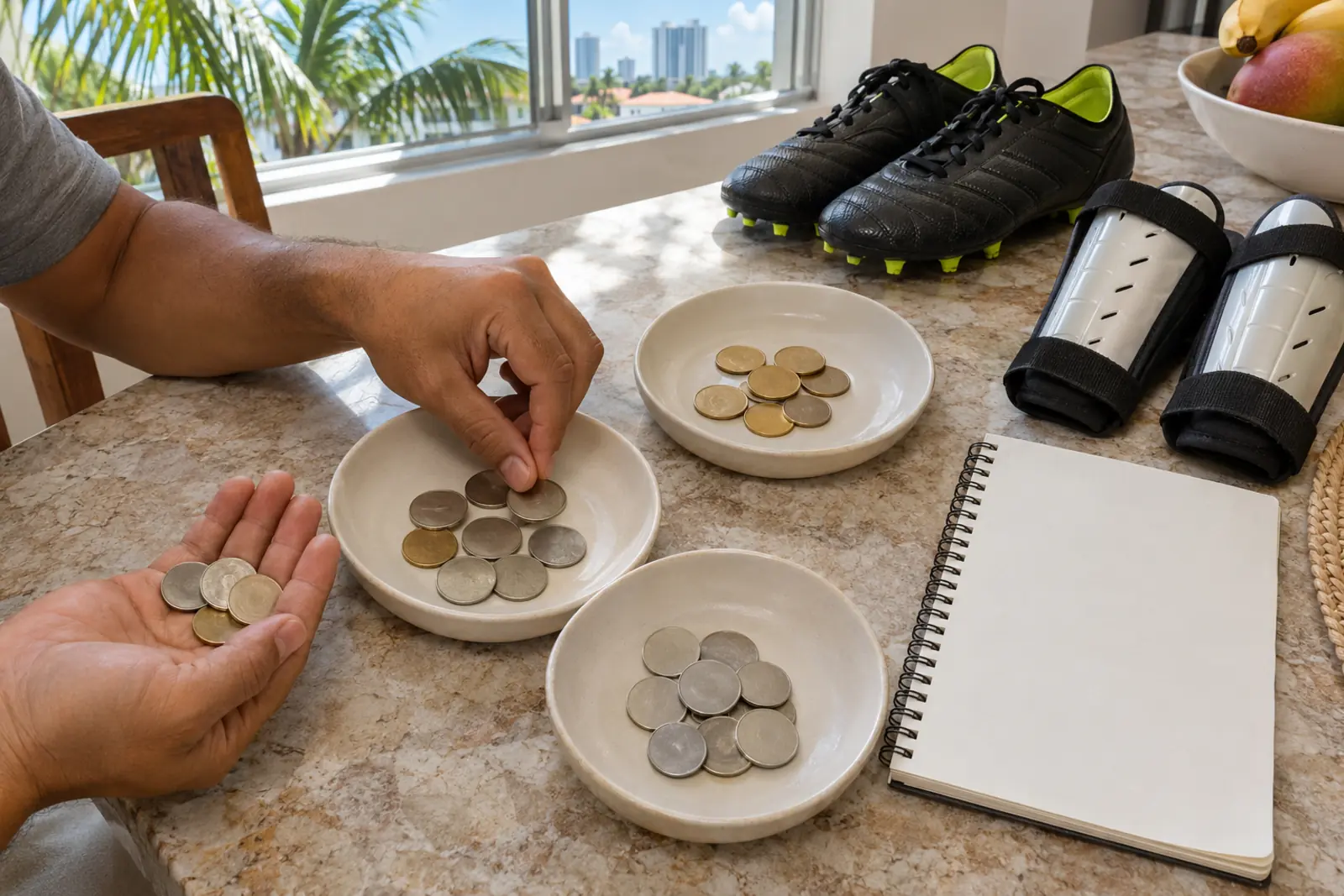
The cost of youth soccer in Miami runs from roughly $150 to $400 in the first year for a recreational league to $2,000 to $4,000 for an entry-level competitive club, $4,000 to $7,000 for a mid-level club with regional travel, and $7,000 to $12,000 or more for an academy-level program. Most of the jump comes from three things that rec soccer does not have: more training days, tournament entry fees and overnight travel.
This page is the all-in family budget: what each level costs per year, which line items are hidden outside the club fee, and where families in South Florida save money. All figures are estimates of widely observed South Florida market conditions, not published price lists. Fees change from season to season, so confirm current numbers with any program you are evaluating.
Youth Soccer Cost per Year in Miami at a Glance
- Recreational league: $150 to $400 in the first year (registration, basic gear, local transportation), then $100 to $250 a year unless the child outgrows gear.
- Entry-level competitive club: $2,000 to $4,000 a year. Club fees, a basic uniform package, starter gear and mostly local tournaments with little overnight travel.
- Mid-level competitive club with regional travel: $4,000 to $7,000 a year. Club fees, a complete uniform and gear setup, several out-of-town tournament trips and perhaps one camp or private-training add-on.
- High-level or academy program at state and national level: $7,000 to $12,000 or more a year. More training volume, longer tournament travel, likely private coaching and the full uniform and gear requirement. Ask the program for an all-in estimate before enrolling.
Why Is Youth Soccer So Expensive?
Competitive youth soccer is expensive because the family pays directly for things a rec league does not charge for: credentialed coaches, field and facility rental, league and player registration, insurance, tournament entries and travel. The difference between a $150 recreational season and a $3,500 club year is mainly training volume (two to four sessions a week instead of one) and a full tournament calendar, not a markup.
In Miami, tournament travel adds to the bill: a popular destination is the Orlando area, a drive of roughly three and a half to four hours from Miami, which turns many weekends into hotel nights. The cheapest club is not always the best value: a $2,800 club with disorganized training and yearly coaching turnover can give less than a $3,500 club with stable coaches and honest player evaluation.
How Miami Youth Soccer Is Structured and What Each Level Costs
Youth soccer in Miami has a cost ladder rather than one price, and most families move up it gradually, meeting a new budget surprise at each step.
Recreational Soccer
Recreational soccer is run by Miami-Dade Parks and Recreation, city parks departments in places such as Coral Gables, Doral, Hialeah, Homestead and North Miami, and community organizations. There are no tryouts. Seasonal registration generally falls between $50 and $200, depending on the city, the age group and whether a jersey is included. Some programs offer subsidized rates for income-qualifying families, so ask the parks department for current fees and enrollment windows.
Outfitting a child from scratch (cleats, shin guards, a correctly sized ball, shorts and socks) typically costs $80 to $150. The usual commitment is one practice and one game a week, with no tournament travel and no multi-piece uniform package, which makes rec soccer the lowest-risk way to start.
Competitive Club Soccer
Competitive clubs in South Florida are usually affiliated with US Youth Soccer (through the Florida Youth Soccer Association, FYSA) or US Club Soccer. A realistic annual club fee is $1,500 to $4,500, and many core competitive teams sit between $2,000 and $3,500. Higher-tier teams in the same club can cost more.
The headline fee usually covers coaching and training sessions (two to four a week), FYSA or US Club Soccer player registration, field and facility costs, and club administration and insurance. It often does not cover:
- The full uniform set (home and away jerseys, shorts, socks). Packages typically cost $150 to $300 and are often ordered from a club-chosen supplier.
- Tournament entry fees, charged per event.
- Travel to away tournaments.
- Expected club gear such as a training top, warm-up jacket or bag ($50 to $150).
Two clubs with the same price can include very different things, so ask for an itemized list rather than comparing headline numbers.
Academy Programs
Academy programs, whether tied to a professional club or independent, train several times a week and compete regionally and nationally. They have the highest fees and the heaviest travel, and they are where the top of the $7,000 to $12,000 range comes from.
Tournament Fees and Travel: The Line Families Underestimate
Most competitive teams enter four to eight tournaments a year. Entry is billed to the team and split among players, so the per-player share depends on roster size. For events within Miami-Dade, Broward or Palm Beach counties, a typical per-player share is roughly $80 to $180 per tournament weekend, covering the entry only, not fuel, food or lodging.
An overnight tournament weekend in the Orlando area for a family of three typically costs $300 to $600 in total for hotel, meals and fuel. Three or four of these a year adds $900 to $2,400 on top of registration and entry fees. A single State Cup, regional or national event can pass $1,000 per family once flights, longer hotel stays and meals are counted. During program evaluation, ask which tournaments are expected and which are optional. See the guide to youth soccer tournaments in Miami and South Florida for how the calendar works.
A Worked Example: One Mid-Priced Competitive Season
Adding up the ranges on this page shows how a club that advertises $2,500 ends up costing much more. For one player on a core competitive team:
- Club fee: $2,500 (a mid-range figure)
- Uniform package: $150 to $300
- Six local tournaments at $80 to $180 each: $480 to $1,080
- Starting gear (cleats, shin guards, training ball, bag): about $115 to $310
That comes to roughly $3,250 to $4,200 before any overnight travel, camps or private training. Add three Orlando weekends at $300 to $600 and the total reaches roughly $4,150 to $6,000, which is why a $2,500 club often belongs in the $4,000 to $7,000 bracket above.
Equipment Costs: Cleats and Playing Surface
Miami's facilities mix natural grass with a large share of artificial turf, and the footwear differs by surface:
- Firm Ground (FG) cleats are the traditional boot for natural grass. They can be uncomfortable and raise injury risk on hard turf.
- Artificial Ground (AG) cleats have shorter, more numerous studs made for 3G and 4G turf, spreading pressure and reducing stress on knees and ankles.
- Turf (TF) shoes have small rubber nubs across the outsole and suit training on hard synthetic surfaces and outdoor courts.
- Indoor (IC) shoes are flat-soled, for futsal courts and indoor facilities.
Players who train on turf often end up with two pairs: AG or TF for training and FG for games on grass. Quality youth cleats from established brands run $50 to $150 a pair. Players training four or more times a week wear cheap footwear out quickly, so mid-range cleats are often the better value over a season.
Other gear for competitive play:
- Training ball: $25 to $50. Clubs usually ask players to bring their own to practice.
- Shin guards: $10 to $30, required for organized play. Replace them when they crack or no longer cover the shin.
- Equipment bag: $30 to $80.
- Insulated water bottles: $25 to $50 for one or two. Hydration matters in South Florida summers; see the heat safety guide for Miami youth soccer.
Goalkeepers need gloves ($25 to $80 a pair, with many keepers keeping a training pair and a game pair) and often padded shorts for turf. Budget an extra $150 to $300 a year; the youth goalkeeper training guide covers the position in detail.
Add-On Costs That Catch Families Off Guard
Private Training
Private or small-group coaching is common among competitive players, at a South Florida market range of $60 to $150 per hour-long session. Two sessions a month adds $1,500 to $3,600 a year. Ask whether club training already covers what the player needs; the private soccer training guide explains how to judge that.
Camps
A week-long day camp typically costs $250 to $450, and residential camps with travel can run $900 to $1,500 or more a week. Multiply by the number of children playing. Options and what to look for are in the guide to youth soccer camps in Miami.
Futsal and Team Extras
Many Miami players add a fall or winter futsal season, with league fees generally $100 to $300 a season. For why it is popular here, see the futsal guide for Miami players. End-of-season events and team dinners add small per-family costs that accumulate over a year.
How to Reduce Youth Soccer Costs in Miami
- Ask about aid before enrolling. Many South Florida clubs offer need-based scholarships or installment plans, and most would rather split payments than lose a player. Ask for the policy up front.
- Look at the US Soccer Foundation. It funds access programs for underserved youth through community organizations and clubs. Its website lists current programs and eligibility; ask your club whether it takes part, since availability changes yearly.
- Buy used gear. Cleats, shin guards and bags circulate through local Facebook Marketplace listings and neighborhood or soccer buy-sell groups. Check the outsole studs on used cleats for uneven wear.
- Buy on clearance. End-of-season sales, typically in late winter and late fall, can cut cleat prices by 30 to 50 percent compared with in-season retail. Because Miami plays year-round, you can time purchases to retail sales rather than the local season.
- Start in rec. If the child is new to the sport, one rec season shows whether the commitment is real before a club contract.
Frequently Asked Questions
How much does competitive youth soccer cost per year in Miami?
For a player on a mid-level competitive club team in South Florida, total annual costs including registration, uniform, tournament fees and travel typically fall between $4,000 and $7,000. Entry-level competitive programs run about $2,000 to $4,000, and elite academy programs can reach $7,000 to $12,000 or more. These are estimates, so confirm current fees with each program.
Are there financial aid programs for Miami youth soccer families?
Yes. Many clubs offer need-based aid or payment plans, so ask directly before assuming cost is a barrier. The US Soccer Foundation funds access programs through partner organizations, and Miami-Dade Parks and Recreation offers low-cost recreational options.
What gear does my child need to start playing soccer in Miami?
For recreational soccer: cleats suited to the field surface, shin guards and a ball in the right size, which is size 3 for ages 5 to 8, size 4 for ages 8 to 12 and size 5 from age 13. Most rec leagues provide a jersey, and starter gear typically costs $80 to $150. For competitive play, add a second pair of cleats for a different surface, a training bag and insulated water bottles.
Do Miami soccer clubs offer payment plans?
Most established clubs can arrange installments for families who ask. Some build them into enrollment and others handle them case by case. Ask before you sign.
How do youth soccer costs change as my child gets older?
Costs generally rise with age and level, because older teams have more tournaments, longer travel and heavier training, and players aiming for college recruitment add showcase and exposure events. As a rough planning benchmark, some families budget for a 15 to 25 percent yearly increase as a child moves from the U10 to U14 to U18 age groups. See the guides to age groups and college soccer recruiting for what changes at each stage.
Is the added cost of travel tournaments worth it?
For serious competitive players it can be, provided the team meets strong opposition and the coaches use tournaments for real development. One-sided local events every weekend do less for growth than a quality regional tournament. Ask the coach honestly whether the events on the schedule offer that level of competition before adding travel to your budget.
Questions to Ask Any Club Before You Commit
- What is the total annual cost when registration, uniform and expected tournament fees are all included?
- Are tournament fees included in the annual fee or billed per event?
- Do you offer financial aid, scholarships or payment plans, and how do we apply?
- What happens to our fees if my child is injured and misses significant playing time?
- What other costs should we expect over a full year?
- What surfaces do your teams train and play on most, and what cleats do you recommend?
Ask for an itemized full-year cost, and ask whether you can watch a training session first. A club that cannot answer these clearly is worth reconsidering. For related reading, see the guides to travel soccer, choosing a program, and leagues.